

Tai Chi Indoor Walking: Strengthen Mind-Body at Home
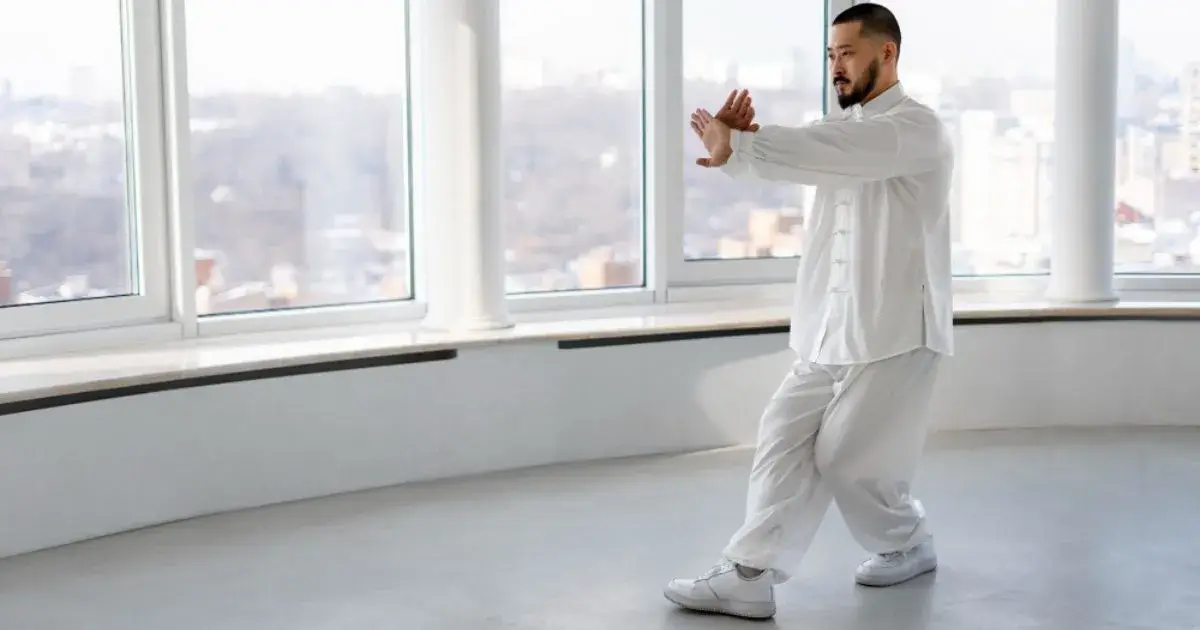
We often associate fitness with speed—how fast we can run, how many steps we can cram into an hour, or how high we can spike our heart rate.
However, a quiet shift is happening in the world of wellness.
Driven by an aging population seeking autonomy and stressed professionals seeking mental clarity, the focus is turning inward.
The practice is Tai Chi Walking. Unlike standard walking, which biomechanically resembles a “controlled fall,” Tai Chi walking is a sophisticated neuromuscular exercise.
It decouples weight transfer from foot placement, turning a simple hallway stroll into a rigorous training ground for your vestibular system.
It does not require a gym, special equipment, or even a large room.
If your main goal is weight loss, start with our guide to tai chi walking for weight loss. This page is specifically about indoor practice, balance, and stress relief at home.
What Is Tai Chi Indoor Walking? (The Expert Definition)
@care.comfort.cure Improve balance with Tai Chi walking, as demonstrated by Dr. Ching Chi, PhD, LAc. This is a great exercise especially for the elderly! #balance #balanceexercise #elderly ♬ Ok I Like It – Milky Chance
To define what is tai chi indoor walking, we must first strip away the misconception that it is simply “slow motion walking.”
Technically, it is a mindful gait training protocol derived from traditional martial arts (Bu Fa or footwork).
In normal gait, we rely on momentum: we lean forward, and our leg swings out to catch us.
This momentum generates ground reaction force (impact) that travels up the kinetic chain to the knees and hips.
Tai Chi walking inverts this process using a principle called Substantial and Insubstantial Separation:
- The Insubstantial (Empty) Step: The moving foot touches the ground with zero weight initially. It tests the surface like a paw.
- The Substantial (Full) Step: Only once the foot placement is verified does the weight “pour” into the leg, shifting the center of mass completely.
The “Indoor” Advantage
While the technique is identical to outdoor practice, the “indoor” constraint is actually a feature, not a bug.
Small spaces (like a 10-foot hallway) force you to focus on the quality of the step rather than the quantity of distance.
The frequent need to turn around challenges the vestibular system (inner ear) more than walking in a straight line, accelerating balance adaptations.
The Science: Why Clinical Experts Are Prescribing This
Current research moves Tai Chi Indoor Walking from “alternative medicine” to “evidence-based intervention.”
Here is what the data says:
1. Fall Prevention: Verify Before You Commit
Falls usually come from a failure of weight transfer — you commit to a leg before it is ready to hold you. Tai chi walking drills the opposite habit, and it has the strongest fall-prevention evidence of any single exercise: see our guide to tai chi walking for seniors for the trial data.
2. Cognitive “Dual-Tasking”
Walking on a treadmill allows your mind to wander. Tai Chi walking requires cognitive inhibition.
You must actively filter out distractions to monitor:
- Heel-to-toe roll
- Knee alignment
- Breath synchronization
- Weight distribution percentages
This “dual-task” processing (moving while thinking) has been shown to improve executive function and working memory, acting as a buffer against cognitive decline.
3. The “Peripheral Heart” Effect
Even without high speed, this practice aids cardiovascular health.
The slow, deep contraction of the quadriceps and calf muscles acts as a pump, aiding venous return (pushing blood back up to the heart).
This lowers the workload on the heart muscle itself while maintaining healthy circulation.
The Protocol: How to “Walk Like a Cat” (Step-by-Step)
To perform this correctly, you must visualize walking on a frozen lake.
If you stomp, the ice breaks. If you commit weight too early, you slip.
Phase 1: The Setup
- Space: A clear path of 6–10 feet is sufficient.
- Footwear: Barefoot or non-slip socks are superior to shoes. You need to “feel” the floor.
- Posture: Imagine a string pulling the crown of your head upward. Tuck your chin slightly. Unlock your knees (never stand with straight legs).
Phase 2: The 5-Step Cycle
Follow this cycle for every single step. Do not rush.
- Rooting (100% Weighted): Stand on your Right Leg. Sink your hips slightly. Your nose, knee, and toe should align.
- Peeling: Lift the Left Heel slowly. Imagine peeling a piece of sticky tape off the floor.
- The “Empty” Extension: Reach the Left Foot forward. Do not shift your body yet. Touch the Left Heel to the floor as light as a feather.
- Check: If someone kicked your foot right now, it should fly away easily because there is no weight on it.
- The Pour: Slowly shift your weight forward. Roll from the Left Heel → Arch → Toe.
- Visualization: Imagine pouring water from a full pitcher (Right Leg) into an empty one (Left Leg).
- Alignment: Once 100% of the weight is on the Left Leg, ensure the knee is bent and stable. Then, begin the cycle with the Right Foot.
Phase 3: The Turn (For Small Spaces)
When you reach the wall, do not just spin around.
- Stop with weight on the back leg.
- Turn the empty front foot inward (pigeon-toed) or outward 45 degrees.
- Shift weight onto it.
- Bring the other foot around to face the new direction.
Critical Distinctions: What This Is NOT
To rank your understanding of the topic, it is vital to distinguish Tai Chi Indoor Walking from similar-sounding trends.
- Vs. “ChiWalking”:
- ChiWalking is a branded, commercialized fitness method designed for runners and power walkers to increase speed and efficiency outdoors.
- Tai Chi Indoor Walking is a traditional somatic practice focused on slowness, stability, and internal energy (Qi), not distance.
- Vs. The “Fart Walk” (Trend):
- A recent viral trend suggests walking after meals for digestion. While Tai Chi walking does aid digestion via parasympathetic activation (rest and digest), its primary goal is neurological balance, not just metabolic speed.
Expert Tips & Common Mistakes
Avoid these biomechanical errors to ensure safety and effectiveness.
- The “Plod”: If your foot makes a thud when it lands, you are falling onto your foot. The step must be silent.
- The Knee Collapse: When shifting weight forward, do not let your knee cave inward (pronate). Keep the knee tracking in line with the second toe to protect the ACL/MCL.
- The “Zombie” Gaze: Do not stare at your feet. This disrupts your vestibular system. Keep your gaze soft and on the horizon; feel your feet with your mind, not your eyes.
- Over-Striding: Do not take huge steps. A shorter stride allows you to keep your spine vertical. If you step too far, you will have to lean forward, breaking your alignment.
FAQs: Mastering the Details
Can I do Tai Chi indoor walking on a carpet?
Yes, but a firm surface (wood, tile, laminate) is better for beginners. Thick carpet can mask the feedback your nerves send to your brain about balance. If you must use carpet, be extra vigilant about lifting your toes to avoid tripping.
How often should I practice to see results?
Consistency beats intensity. Clinical studies often cite protocols of 20–30 minutes, 3 times per week. However, even 5–10 minutes daily as a “brain break” from work can improve focus and lower cortisol levels.
Is this safe for someone with bad knees?
Generally, yes. Because there is zero impact force (no heel strike shock), it is safer than regular walking. However, you must keep your knees “soft” (slightly bent) but not deeply bent. A high stance is just as effective for balance as a low martial arts stance and is much easier on the joints.
Does walking backwards help?
Yes. Once you master forward walking, reversing the process (placing the toe first, then rolling to the heel) engages different muscle chains (glutes and hamstrings) and forces the brain to rely entirely on proprioception rather than vision.
Conclusion
Understanding what is tai chi indoor walking reveals a tool that is surprisingly relevant for the modern age.
It answers the need for movement that heals rather than harms, and focuses rather than distracts.
By trading momentum for mindfulness, you turn the limited space of your home into a laboratory for longevity.
The goal is not to get to the other side of the room; the goal is to master the space between your steps.
Action Plan:
- Clear a 10-foot path today.
- Take off your shoes.
- Try 5 minutes of the “Cat Walk” protocol.
- Notice the silence of your steps and the engagement of your core.